Medicare Supplement Guaranteed Issue: What Happens When Your Medicare Advantage Plan Ends?

By Melody Bundy | Medicare & Life Insurance Broker | Frontier Insurance Services
"Wait a minute. Are you telling me I may be able to purchase a Medicare Supplement policy even though I've had health problems?"
That's a question worth asking.
If your Medicare Advantage plan is ending December 31, 2026, you may have an important opportunity to reconsider how you receive your Medicare coverage.
And it's an opportunity some beneficiaries don't realize exists.
I've been helping individuals navigate Medicare since 2008. One of the things I've learned is that Medicare decisions can become confusing when unfamiliar terms enter the conversation.
Terms like guaranteed issue, medical underwriting, and Medigap aren't exactly everyday language.
As a former teacher, I enjoy breaking down those concepts into information people can actually use.
Let's look at what guaranteed issue means, who may qualify, and why it's worth understanding when your Medicare Advantage plan ends.
Consultations are at no cost and without obligation. Available by phone, Zoom, and limited in-person appointments.
What Is Medicare Supplement Insurance?
Medicare Supplement Insurance, also called Medigap, is private insurance designed to help pay certain out-of-pocket costs associated with Original Medicare.
Original Medicare includes Part A and Part B.
Part A generally covers inpatient hospital services, while Part B covers certain medically necessary outpatient services and medical care.
Even with Original Medicare, beneficiaries may have deductibles, coinsurance, and copayments.
Medigap helps pay some of those costs, depending on the policy selected.
Unlike Medicare Advantage, Medigap works alongside Original Medicare rather than replacing how you receive your Medicare-covered benefits.
You can generally receive covered care from any healthcare provider throughout the United States who accepts Medicare.
A Medicare Supplement policy does not generally include outpatient prescription drug coverage, so beneficiaries usually consider a separate Medicare Part D plan.
What Does Guaranteed Issue Mean?
Normally, outside certain protected enrollment periods, insurance companies in many states may use medical underwriting when someone applies for Medicare Supplement coverage.
That can mean reviewing medical history to determine eligibility or pricing.
But certain situations create special protections.
These are called guaranteed-issue rights.
When you qualify, insurers generally must offer eligible Medigap coverage under the applicable rules without denying you because of your health history or increasing your price because of your medical conditions.
This is particularly relevant when your Medicare Advantage plan is leaving Medicare or stops covering your area.
Example: Your Medicare Advantage Plan Is Ending
Imagine you've had Medicare Advantage for seven years.
During that time, you've developed several health conditions and begun seeing specialists regularly.
Now your plan is ending December 31.
You might assume that purchasing a Medicare Supplement policy is impossible because of your health history.
But your plan termination may qualify you for federal guaranteed-issue protections.
That's why reviewing your rights is important before deciding what to do next.
Your health history doesn't automatically eliminate this opportunity.
Which Medicare Supplement Plans Qualify?
For the federal guaranteed-issue situation in which your Medicare Advantage plan leaves Medicare or stops serving your area, eligible beneficiaries who return to Original Medicare generally have protections for certain standardized Medigap policies.
These include Plans A, B, C, D, F, G, K, and L, subject to eligibility, availability, and applicable rules.
Plans C and F are not available to people who became newly eligible for Medicare on or after January 1, 2020.
Plan N is not included in this specific federal guaranteed-issue list.
That doesn't mean Plan N can never be purchased. Other enrollment opportunities, underwriting rules, or additional state protections may apply.
It's important to distinguish between a policy being available for purchase and your having a guaranteed right to buy it.
Medicare Supplement Comparison Chart
One of the tools I use when educating clients is the Medicare Supplement comparison chart from the official Medicare & You handbook.
Most states use standardized Medigap plan letters, meaning policies with the same letter generally provide the same standardized medical benefits, regardless of the insurance company.
Premiums, however, can vary significantly.
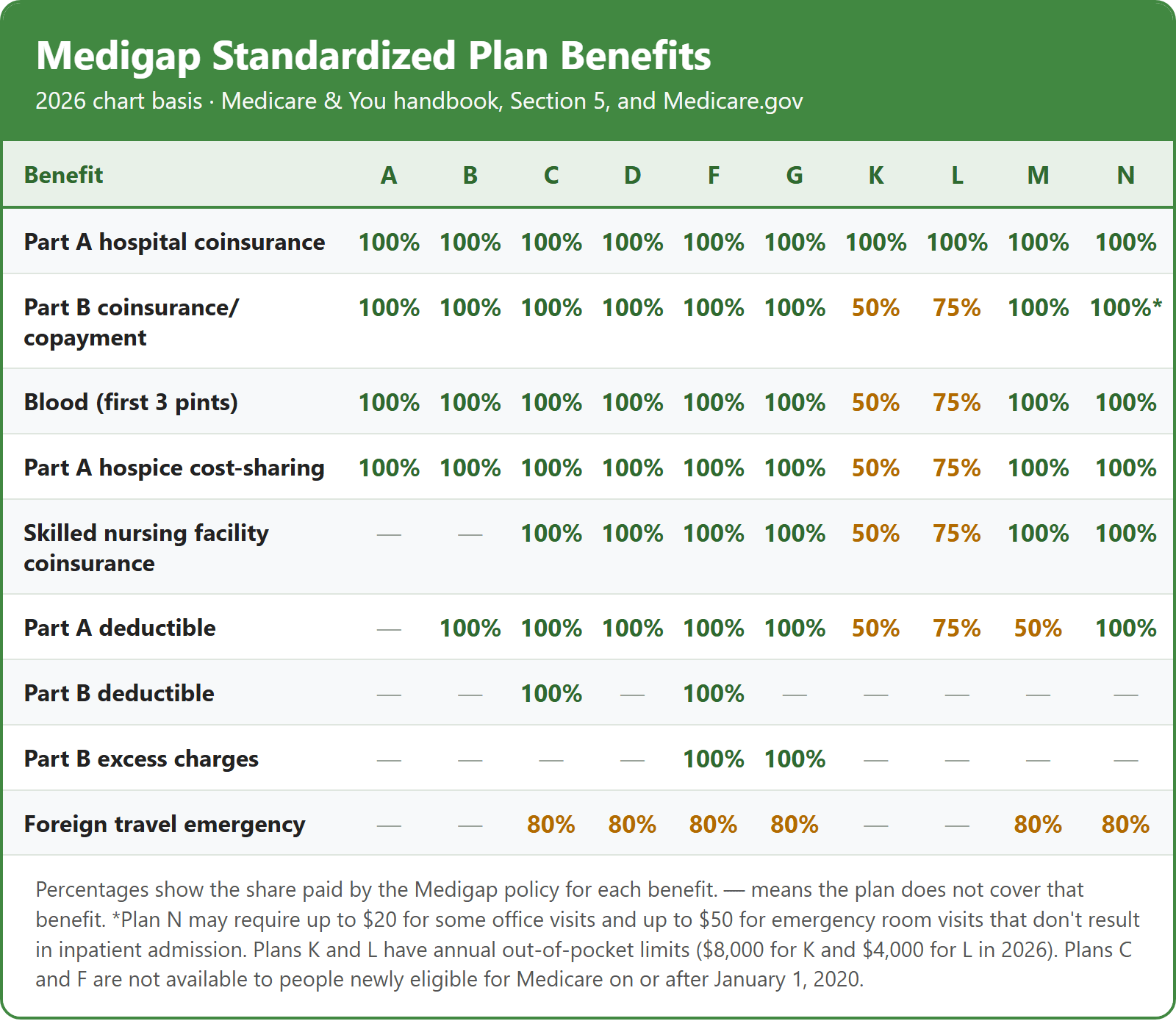
The chart below shows the percentage of specific benefits covered by each standardized plan.
Important Chart Notes
- Plans C and F cannot be purchased by people who became newly eligible for Medicare on or after January 1, 2020.
- Plans F and G may have high-deductible versions in some states.
- Plan N covers Part B coinsurance but may require up to $20 for some office visits and up to $50 for emergency room visits that don't result in inpatient admission.
- Plans K and L have annual out-of-pocket limits. The official chart lists $8,000 for K and $4,000 for L in 2026. These are not represented as 2027 limits.
Official source: Medicare & You 2027 handbook and the Medicare.gov Medigap comparison.
Keep in mind that Massachusetts, Minnesota, and Wisconsin use different Medigap standardization systems.
What About Plans F, G, and N?
These are three plans beneficiaries frequently ask me about.
Plan F provides broad standardized coverage, including the Part B deductible, but purchase eligibility is limited based on when someone first became eligible for Medicare.
Plan G covers many of the same standardized benefits as Plan F, except the Part B deductible.
Plan N generally covers Part B coinsurance but may require copayments for certain office and emergency room visits. It also doesn't cover Part B excess charges.
There are also high-deductible versions of Plans F and G available in some states.
I'll discuss these plans and their differences in greater detail in a separate article.
For now, understand that having the same plan letter doesn't mean every company charges the same premium.
Why Might Someone Consider Medigap?
One reason people consider Original Medicare with a Medicare Supplement is flexibility.
Under Original Medicare, you can receive covered care from doctors and hospitals across the country that accept Medicare.
This can be useful for someone who:
- Travels frequently or spends winters in another state.
- Sees multiple medical specialists.
- Wants fewer provider-network restrictions.
- Prefers more predictable cost-sharing for covered medical services.
However, flexibility isn't the only consideration.
Medigap policies typically require an additional monthly premium.
You'll generally continue paying the Medicare Part B premium and may also pay for a standalone prescription drug plan.
Medicare Advantage plans, meanwhile, have annual out-of-pocket limits for covered Part A and Part B services and may offer additional benefits not included in Original Medicare.
So neither arrangement should automatically be considered better for everyone.
When Do Guaranteed-Issue Rights Begin and End?
For qualifying beneficiaries whose Medicare Advantage coverage ends December 31, 2026, the federal guaranteed-issue application window generally begins 60 days before that coverage ends and continues for no more than 63 days afterward.
That makes November 1, 2026, through March 4, 2027, the general application window for this particular December 31 coverage termination.
Specific circumstances or additional state protections may affect your rights.
Medigap coverage cannot start while your Medicare Advantage coverage is still active.
And remember, this particular guaranteed-issue protection generally applies when you return to Original Medicare, rather than joining another Medicare Advantage plan.
Keep Your Termination Notice
Your insurance company's letter may be needed to prove that you qualify for guaranteed issue.
Don't throw it away.
The notice often contains important details about your plan's termination and special enrollment opportunities.
How I Help Clients Compare Their Choices
When someone contacts Frontier Insurance Services, I begin by asking what they've already learned and how their current coverage has worked.
I want to know what they liked, what frustrated them, and what concerns they have about the future.
Then we review their doctors, prescriptions, recent medical experiences, travel habits, and budget.
If they're considering Medigap, we look at the available policy letters, standardized benefits, premiums, and applicable enrollment rights.
We also compare prescription drug plans separately.
I believe clients should understand their choices before enrolling.
My background as a former teacher helps me explain Medicare concepts without overwhelming people with insurance terminology.
Think of me as your Medicare broker with the heart of a teacher.
Don't Overlook This Opportunity
Losing a Medicare Advantage plan can be stressful.
But it may also provide a chance to reassess whether your current type of coverage still fits your life.
You might choose another Medicare Advantage plan.
You might explore Original Medicare with Medigap and Part D.
The important thing is understanding your rights and deadlines before making a decision.
Schedule Your Medicare Supplement Review
Consultations are at no cost and without obligation.
Melody Bundy
Medicare & Life Insurance Broker
Frontier Insurance Services
Phone: 973-981-4919
Email: [email protected]
Website: www.insurewithfrontier.com
Appointments are available by phone, Zoom, and limited in-person meetings.
Important Medicare Disclosures
CMS TPMO Disclaimer
We do not offer every plan available in your area. Currently we represent 7 organizations which offer 40 products in your area. Please contact Medicare.gov or 1-800-MEDICARE to get information on all of your options.
Additional Disclosure
Frontier Insurance Services is an independent insurance agency and is not affiliated with or endorsed by the U.S. government or the federal Medicare program.
Medigap guaranteed-issue rights depend on individual eligibility, state law, the reason coverage ends, and applicable deadlines. Not every Medigap policy is available to every applicant. This content is educational and does not guarantee insurance eligibility or acceptance.
Consultations are at no cost and without obligation.
For official information, visit Medicare.gov or call 1-800-MEDICARE (1-800-633-4227).
Contact Us
Start Your Medicare Plan
Have questions about Medicare or health coverage?
Send us a message and let’s find the right plan for your needs.