Medicare Advantage HMO vs. PPO: Which Fits Your Healthcare Needs?

By Melody Bundy | Medicare & Life Insurance Broker | Frontier Insurance Services
"My friend has a PPO, and she says it's better than an HMO. Should I switch?"
I hear questions like this regularly.
And my response is usually another question:
"Better for whom?"
Because your friend's doctors, medications, medical needs, and budget may look completely different from yours.
If you're reviewing Medicare Advantage coverage for 2027, especially because your current plan is ending, understanding the difference between an HMO and PPO is an important place to start.
I've helped people navigate Medicare since 2008, and as a former teacher, I believe that understanding how your coverage actually works is just as important as selecting a plan.
Let's break it down.
Consultations are at no cost and without obligation. Available by phone, Zoom, and limited in-person appointments.
What Is a Medicare Advantage Plan?
Medicare Advantage, also known as Medicare Part C, is an alternative way to receive your Medicare Part A and Part B benefits through a Medicare-approved private insurance company.
Most Medicare Advantage plans include prescription drug coverage, although not every plan does.
Some plans offer supplemental benefits that Original Medicare doesn't generally include, such as certain dental, vision, hearing, or fitness benefits.
But Medicare Advantage plans aren't all structured the same way.
Two common types are HMOs and PPOs.
What Is a Medicare Advantage HMO?
HMO stands for Health Maintenance Organization.
An HMO generally uses a network of doctors, hospitals, and other healthcare providers.
For most nonemergency covered care, you'll typically need to use providers within that network, with certain exceptions.
Some HMO plans also require referrals before visiting certain specialists.
Example: You Have a Favorite Cardiologist
Let's say you've been seeing the same cardiologist for several years.
You find an HMO plan with a monthly premium that fits your budget.
That sounds promising.
But before you enroll, we need to confirm whether your cardiologist participates in that specific HMO network.
And here's something important:
A doctor accepting Medicare doesn't automatically mean that doctor participates in every Medicare Advantage plan.
That's a misunderstanding I frequently address when reviewing coverage with clients.
We also need to review any referral requirements and costs associated with your visits.
Why Might Someone Consider an HMO?
Some beneficiaries appreciate having coordinated healthcare through a defined provider network.
Depending on the specific plan, HMOs may also offer lower costs for certain services compared with other available options.
But the benefits depend on the actual plan.
The trade-off is that nonemergency out-of-network coverage is generally more restricted.
What Is a Medicare Advantage PPO?
PPO stands for Preferred Provider Organization.
A PPO generally allows beneficiaries to receive covered services from both in-network and out-of-network providers who agree to treat them, subject to the plan's rules.
However, you'll generally pay less when using in-network providers.
PPOs also generally don't require referrals to see specialists.
Example: You Travel Between New Jersey and Florida
Imagine you live in New Jersey but spend several months each year visiting family in Florida.
You might want more flexibility if you need medical care while traveling.
A PPO could be worth exploring because some PPO plans cover nonemergency services from eligible out-of-network providers.
But don't assume every doctor accepts every PPO plan.
We still need to confirm the plan's coverage rules, whether providers will treat you, and what you may pay out of network.
Emergency and urgently needed care have special protections under Medicare Advantage rules.
The goal is to understand your coverage before you need to use it.
HMO vs. PPO: A Simple Comparison
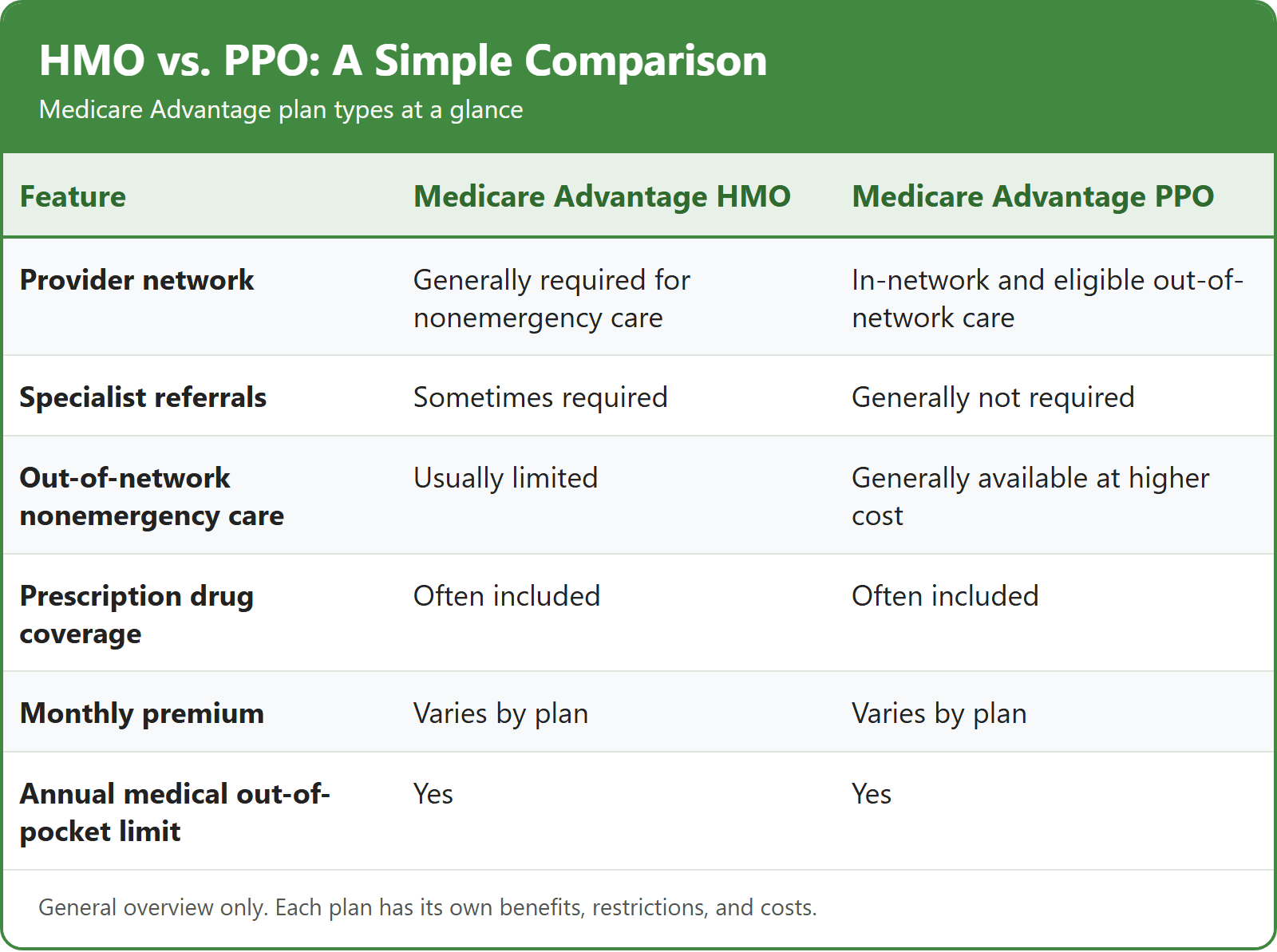
The chart gives you a general overview, but each plan has its own benefits, restrictions, and costs.
Never assume two HMOs or two PPOs work exactly the same way.
Don't Make Your Decision Based on the Premium Alone
One of the biggest mistakes beneficiaries can make is focusing exclusively on the monthly premium.
For example, you might be considering one plan with a $0 premium and another with a monthly premium.
The $0-premium plan may initially seem like the obvious choice.
But what if your specialist copayments are higher?
What if one of your prescriptions is on a more expensive tier?
What if your preferred hospital isn't in the network?
Those differences matter.
When I help clients compare Medicare Advantage plans, I look at the broader financial picture.
That includes premiums, deductibles, copayments, coinsurance, prescription expenses, and the maximum amount you could pay out of pocket for covered Part A and Part B services.
The lowest monthly premium doesn't necessarily mean the lowest overall healthcare cost.
Your Prescription Drug Coverage Deserves Its Own Review
Prescription coverage is another area where clients are often surprised.
A medication may appear on multiple plans' covered drug lists, called formularies.
But the amount you pay may differ based on the drug tier and pharmacy.
For instance, your current pharmacy might be preferred under one plan but offer standard cost-sharing under another.
That's why I use Medicare.gov to compare estimated prescription expenses using each client's medication list and pharmacy preferences.
We also consider important restrictions, such as prior authorization, step therapy, and quantity limits.
Your medications deserve more than a quick glance.
What If Your Current Medicare Advantage Plan Is Ending?
If you've received a letter stating that your Medicare Advantage plan will no longer be available after December 31, 2026, you may be considering several options. I walk through each of them in My Medicare Advantage Plan Is Ending December 31, 2026. What Are My Options?
You could enroll in another Medicare Advantage HMO.
You could explore a PPO.
Or you could consider returning to Original Medicare and purchasing a Medicare Supplement and standalone prescription drug plan, if eligible.
The right decision depends on your needs and the coverage available in your area.
And remember that if your plan is ending, you may have special enrollment rights, including potential guaranteed-issue rights for certain Medicare Supplement policies.
That's one reason I encourage clients to understand both Medicare Advantage and Original Medicare before making their final decision.
My Medicare Review Process: Five Questions I Ask
As a former teacher, I know that asking the right questions is often the beginning of understanding.
When someone contacts Frontier Insurance Services, I usually start with five areas.
1. What did you like or dislike about your current plan?
If you've been happy with your coverage, I want to understand why. And if something hasn't worked, let's discuss it.
2. Which doctors and hospitals matter most?
We'll review your preferred providers and investigate their participation in the plans you're considering.
3. What medications do you take?
We'll review your medication list and compare prescription coverage and estimated costs.
4. What does your lifestyle look like?
Do you travel frequently? Spend time in another state? Prefer to stay close to home?
5. What's comfortable for your budget?
We'll discuss monthly premiums and potential expenses when you receive medical care.
Some clients come to me with spreadsheets and pages of research.
Others simply say, "Melody, I don't understand any of this."
Both are welcome.
My role is to listen, explain, compare, and help you understand your available options.
So, Is an HMO or PPO Better?
That depends on you.
An HMO may suit someone who is comfortable using a defined provider network.
A PPO may appeal to someone who prefers additional flexibility when receiving care.
But the plan's specific doctors, benefits, costs, and coverage restrictions matter much more than the three-letter abbreviation.
Don't choose a PPO simply because your friend has one.
And don't automatically reject an HMO because someone else had a negative experience.
Choose coverage based on your healthcare needs—not someone else's Medicare story.
Let's Make Medicare Make Sense
I've been helping individuals navigate Medicare since 2008.
My background as a teacher continues to influence how I work with clients.
I want you to understand your choices, feel comfortable asking questions, and have the information necessary to make an informed decision.
Think of me as your Medicare broker with the heart of a teacher.
Schedule Your Medicare Consultation
Consultations are at no cost and without obligation.
Melody Bundy
Medicare & Life Insurance Broker
Frontier Insurance Services
Phone: 973-981-4919
Email: [email protected]
Website: www.insurewithfrontier.com
Appointments are available by phone, Zoom, and limited in-person meetings.
Important Medicare Disclosures
CMS TPMO Disclaimer
We do not offer every plan available in your area. Currently we represent 7 organizations which offer 40 products in your area. Please contact Medicare.gov or 1-800-MEDICARE to get information on all of your options.
Additional Disclosure
Frontier Insurance Services is an independent insurance agency and is not affiliated with or endorsed by the U.S. government or the federal Medicare program.
This article provides general Medicare education. HMO and PPO availability, provider networks, prescription coverage, costs, and plan benefits vary by location and specific plan. Provider participation and benefits should be confirmed before enrollment.
Consultations are at no cost and without obligation.
For official Medicare information, visit Medicare.gov or call 1-800-MEDICARE (1-800-633-4227).
Contact Us
Start Your Medicare Plan
Have questions about Medicare or health coverage?
Send us a message and let’s find the right plan for your needs.