Term vs. Whole Life Insurance: Are You Renting or Buying Your Protection?

By Melody Bundy | Medicare & Life Insurance Broker | Frontier Insurance Services
"I know I probably need life insurance, Melody, but I just can't afford another monthly bill."
"I'm too old to get life insurance."
"My children are grown. Do I really need it?"
"I have some savings. My family should be fine."
And one of the statements I hear most often:
"Let me think about it."
As an insurance broker, I've learned that sometimes people aren't saying they don't want life insurance. They're saying they're afraid to make another financial commitment.
Fear of dying. Fear of the unknown. Fear of another bill showing up when money is already tight.
I understand those concerns.
But I also believe people deserve to understand their options before deciding whether life insurance fits their budget.
So today, we're having a simple five-minute life insurance lesson.
No complicated insurance language. No pressure.
Just a conversation about two common types of life insurance: term life and whole life.
Consultations are at no cost and without obligation. Available by phone, Zoom, and limited in-person appointments.
1. Life Insurance Is Like Renting or Buying a Home
Think about the difference between renting an apartment and buying a house.
When you rent, you're paying for a place to live during an agreed period.
When you buy, you're generally making a longer-term commitment.
Both serve a purpose. Neither is automatically better.
Life insurance works in a somewhat similar way.
Term life insurance is like renting protection for a specific period.
Whole life insurance is like buying protection designed to last your lifetime.
It's a simple analogy, not a perfect comparison. But it helps explain an important difference.
Let's look at how each works.
2. Term Life Insurance: Renting Protection
Term life insurance covers you for a specified period, commonly 10, 20, or 30 years.
If you pass away during that term while the policy is active, the insurance company pays the applicable death benefit to your beneficiaries.
If the term ends and you don't renew, convert, or otherwise continue the policy, your coverage ends.
Most traditional term life policies don't build cash value.
Who Might Consider Term Life?
Imagine you're 40 years old with two children and a mortgage.
You want financial protection for your family while your children are growing up and your household depends on your income.
A 20- or 30-year term policy may be worth exploring.
Term life generally provides more initial death-benefit coverage per premium dollar than comparable whole life coverage.
However, if your term ends, you may need new coverage or face significantly higher renewal premiums. Some policies offer conversion options, subject to specific rules and deadlines.
Term life isn't necessarily designed to last forever, but it can provide valuable protection during important financial stages.
3. Whole Life Insurance: Buying Long-Term Protection
Now imagine buying a home instead of renting.
You're thinking about the long term.
Whole life insurance is designed to provide lifetime coverage as long as the policy remains in force and required premiums are paid.
It also builds something called cash value.
Depending on your policy, you may be able to borrow against that value or access it through a surrender.
However, cash value isn't the same as money in a regular savings account. Loans generally accumulate interest, can reduce the death benefit, and may cause problems if the policy lapses.
Whole life insurance typically costs more than term life for the same initial death benefit.
But it serves a different purpose.
Who Might Consider Whole Life?
Imagine you're 58 years old.
Your children are grown, and you're thinking about funeral expenses, final bills, and leaving something for your loved ones.
You may be more interested in coverage designed to remain in place for your lifetime than protection limited to a particular period.
Whole life may be worth considering.
Some final expense policies are also forms of whole life insurance, although their benefits, underwriting requirements, and waiting periods may differ.
4. Term vs. Whole Life: A Simple Comparison
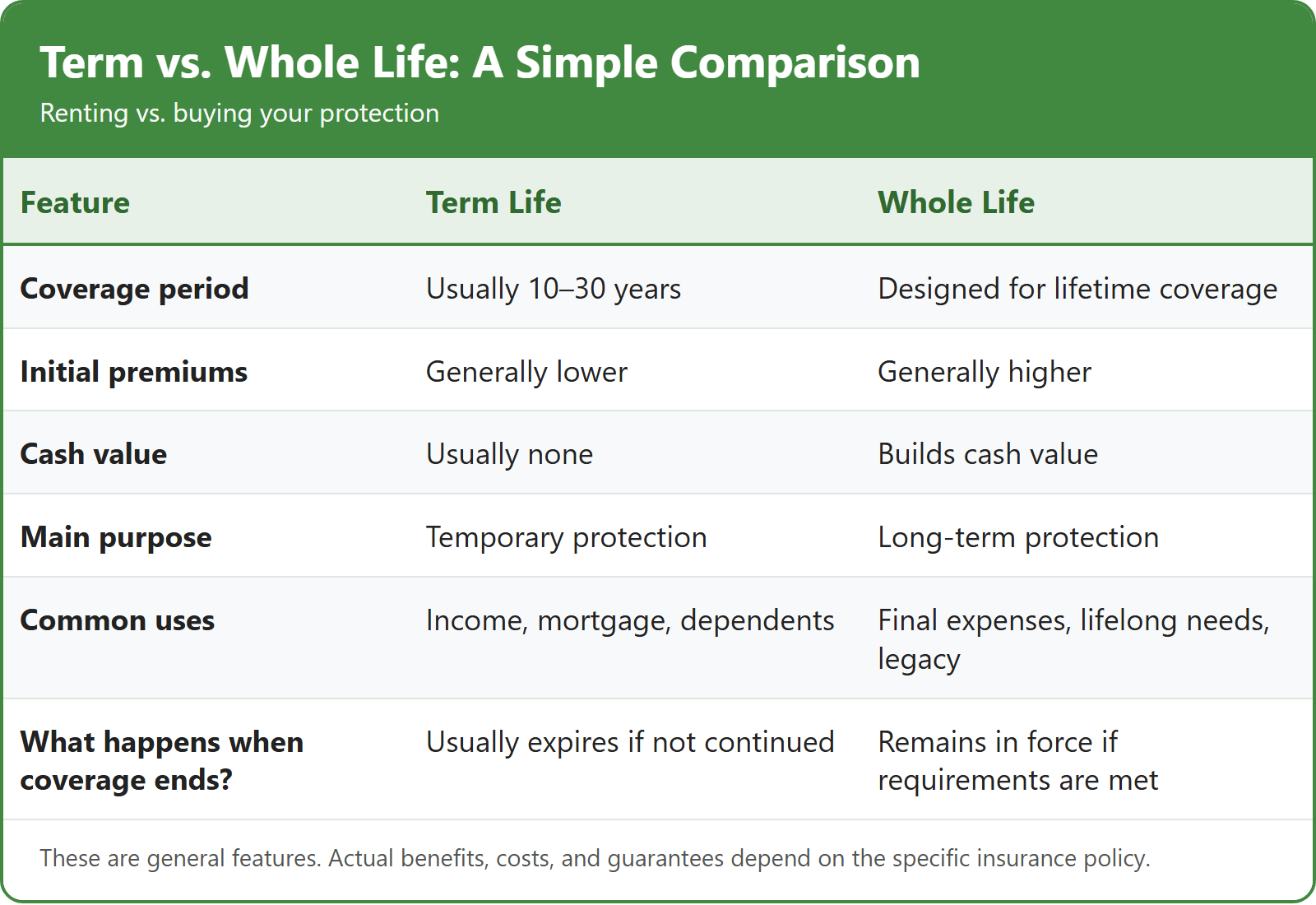
These are general features. Actual benefits, costs, and guarantees depend on the specific insurance policy.
5. "What If I Can't Afford Another Monthly Bill?"
Now let's talk about real life.
You have rent or mortgage payments, groceries, utilities, car insurance, and maybe family members who depend on your help.
The last thing you need is another payment that creates financial hardship.
That's why I encourage clients to think about what they can comfortably maintain, not simply the largest policy they qualify for.
Maybe $50,000 in coverage isn't realistic for your budget.
But perhaps a smaller policy could help with some funeral expenses or other responsibilities.
The right amount depends on your goals, eligibility, and finances.
I'd rather help someone explore a manageable amount of coverage than encourage a policy they may struggle to keep.
Because here's something important:
A life insurance policy needs to remain in force for its coverage to be available when a covered claim occurs.
We should also discuss what happens if payments are missed and what options a policy may offer.
Life insurance shouldn't put your everyday financial security at risk.
6. "Maybe I'll Wait Until Next Year"
I hear this frequently.
And sometimes waiting is a reasonable financial decision.
But other times, people delay because they don't want to think about death.
It's an uncomfortable subject.
The problem is that waiting doesn't guarantee your circumstances will stay the same.
Age and health can affect life insurance premiums and eligibility.
That's why I encourage people to learn about their options rather than automatically assuming coverage is unaffordable.
You may discover a policy that fits.
You may decide your budget isn't ready.
Either way, you'll have more information to make your decision.
7. A Family Story: When Tomorrow Never Comes
This is a hypothetical example illustrating a situation families may face.
Imagine James and Denise, a couple in their early 60s.
They've been married for 35 years, raised their children, and are looking forward to retirement.
They've discussed life insurance, but something always comes up.
The car needs repairs. Property taxes are due. The grandchildren need help.
They keep saying, "We'll look into it next month."
Then James passes away unexpectedly.
Denise is grieving while trying to arrange his funeral.
Their adult children want to help, but they have financial responsibilities of their own.
One suggests using credit cards.
Another mentions starting a GoFundMe campaign.
Someone considers organizing a fundraiser.
Instead of concentrating entirely on remembering James, the family must also figure out how to pay for his arrangements.
And this is why I believe life insurance deserves a place in family financial conversations.
Life insurance cannot take away the pain of losing someone. But an appropriate policy can provide financial resources that may help loved ones manage expenses during a difficult time.
8. Life Insurance Can Be an Act of Love
I sometimes describe life insurance as a love sacrifice.
Not because you must purchase insurance to prove you love someone.
And certainly not because someone who cannot afford coverage loves their family any less.
I mean that some people choose to set aside money today to help provide financial protection for the people they love tomorrow.
We budget for family dinners, vacations, entertainment, and celebrations.
Those experiences are important.
But when you're thinking about your household budget, it may also be worth asking whether there's room for some financial protection.
Not by giving up necessities or creating hardship.
Simply by reviewing priorities.
One day, your loved ones may gather to remember your life.
They'll share stories, laughter, tears, and memories.
If it's financially realistic, life insurance may help them have additional resources to manage expenses during that time.
9. Can You Find It in Your Heart—and Room in Your Budget?
Here's a question I'd like you to consider:
Can you find it in your heart—and room in your budget—to explore a little protection for the people you love?
Notice I didn't say you needed the largest policy.
I didn't say you should sacrifice essential expenses.
And I didn't say everyone needs the same amount of insurance.
Maybe you're concerned about funeral expenses.
Maybe you want to leave something for your spouse or children.
Or maybe you're unsure what coverage would be appropriate.
That's okay.
You don't have to figure it out alone.
10. Let's Start With a Conversation
If you currently have no life insurance, you don't need to begin by choosing an insurance company.
Start with four questions:
Who are you protecting? A spouse, children, grandchildren, or another loved one?
What expenses are you concerned about? Funeral arrangements, outstanding bills, mortgage payments, or income replacement?
How long do you need protection? For a particular period or throughout your lifetime?
What premium could you realistically maintain? Not just today, but over time?
Once we understand your answers, we can explore appropriate life insurance options.
As a former teacher and insurance broker, my approach is education first.
I want you to understand what you're considering before making a decision.
You don't have to start with the biggest policy. Start by understanding your options and what you can comfortably afford.
Reviewing your health coverage at the same time? If your Medicare Advantage plan is ending, read My Medicare Advantage Plan Is Ending December 31, 2026. What Are My Options?
Schedule Your Life Insurance Consultation
Consultations are at no cost and without obligation.
Melody Bundy
Medicare & Life Insurance Broker
Frontier Insurance Services
Phone: 973-981-4919
Email: [email protected]
Website: www.insurewithfrontier.com
Appointments are available by phone, Zoom, and limited in-person meetings.
Frontier Insurance Services — Helping families understand their insurance options.
Contact Us
Start Your Medicare Plan
Have questions about Medicare or health coverage?
Send us a message and let’s find the right plan for your needs.